In honor of rock collecting day, I figured I would talk a little about what a rock actually is. We walk over the things every day and unless we happen to be collectors, probably don’t pay them much mind. Unless of course we find one of those tiny, sharp pebbles with our bare foot - then the war is on. When they aren’t hurting us, rocks can be quite useful. We live in them and sometimes we wear them. And since we obviously don’t make our buildings out of diamonds, there must be different kinds of rocks. These fall into the categories of sedimentary, metamorphic, and igneous.
 |
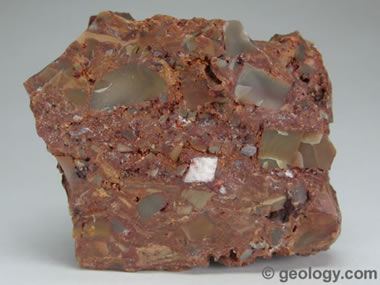
| breccia |
Sedimentary rocks are made up of fragments of other rocks and particles, such as sand, mud, shells, and bones found in calcium-rich water. The weight of other materials compresses these fragments and forms including sandstone, limestone, and mudstone. In the strata layer of sedimentary rock, you can often find fossils.
 |
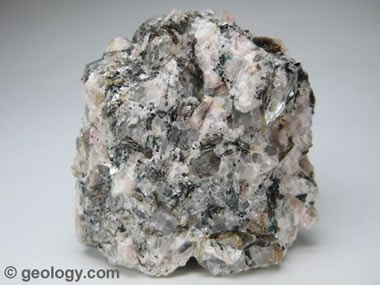
| pegmatite |
Igneous rocks are formed from molten material expelled from volcanoes, or from granite which hardens underground. Granite rock can be found all over the world and are some of the oldest known rocks. The oldest known rocks, found in the Jack Hills mountain range in Australia. They are 4.4 billion year old zircons, a kind of igneous rock.
 |
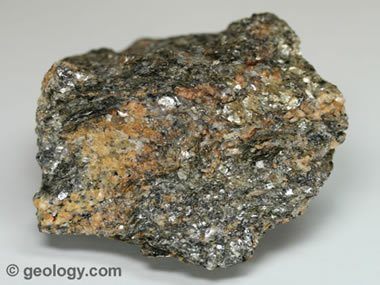
| schist |
When igneous or sedimentary rocks are put under pressure, extreme heat or exposed to fluids, metamorphic rock can be created such as marble or quartzite. These fall into two main types: foliated and non-foliated. Foliated rocks have a banded or layered appearance due to exposure to heat or pressure. Non-foliated rocks do not have this kind or appearance. The rock to the right is schist which is an example of a foliated metamorphic rock.
Despite the pain of stepping on one, it can often lead to an unexpected discovery. I once accidentally came upon a plant fossil while out fishing. What are some of the most interesting rocks you have found?
Sources:
Geology.com
NSF
National Geographic